Will Lankshear to Middlesbrough - why?
Middlesbrough have signed Will Lankshear from Spurs for a fee of between £10 million and £20 million depending on add-ons. As an Oxford United fan, I don’t doubt Lankshear’s commitment or ability, but I wanted to examine why Middlesbrough have chosen to spend a fee potentially rising to a club record on a player whose professional experience is largely composed of one season at relegated Oxford.
It has seemed clear for all to see that Kim Hellberg’s Middlesbrough needed a goal-scoring striker. Last season in the Championship, the team created 2.3 big chances per game, but missed an average of 1.4 of them. Games such as their 1-0 home defeat to Portsmouth (helping to relegate Oxford) exposed their glaring weaknesses around converting chances: they had 71% possession, and around triple Portsmouth’s xG, but failed to score. It was performances like this towards the end of the season which eventually ended their automatic promotion chances - a week earlier, they had 3.35 xG in a 2-1 home defeat to Millwall.
During this horrifying run of chance-conversion, forwards such as Tommy Conway and David Strelec were blamed for not taking the opportunities created by the rest of the team. In Lankshear, Boro hope they’ve found a forward who they can continue to create chances for, but who can finish them with greater consistency. Yet, Lankshear’s profile makes this an intriguing choice; not a bad finisher, but wasn’t most commonly lauded for his finishing by Oxford fans and EFL experts. What stood out most ‘on the ground’ was his work-rate and positioning, attributes which players like Conway could already claim to hold.
At first glance, signing one of the most highly rated young strikers in the EFL seems a simple remedy to Boro’s finishing woes. However, I believe this signing is a bolder risk from Helberg and the recruitment team, but one which could unlock the whole forward line, not just Lankshear.
Where will he play? (and who will he replace?)
Key to understanding this signing is to understand who in Boro’s lineup Lankshear is viewed as an upgrade upon. Hellberg played a variety of formations last year, but rarely deviated from his intense attacking philosophy. Whilst Conway was Boro’s most frequently featuring forward, it was Strelec who most often took up central areas under Hellberg towards the end of the season, with Conway usually playing on the left. I believe it is highly likely Lankshear plays centrally, and could replace Strelec, playing alongside players such as Conway and Morgan Whittaker, who may be deployed out wide or as second strikers. In fact, Strelec and Lankshear had very similar overall heatmaps last year, albeit with Lankshear taking up a greater variety of positions across the front line, likely owing to the extra workload of playing for Oxford, who didn’t great a high volume of chances for any of our forwards.
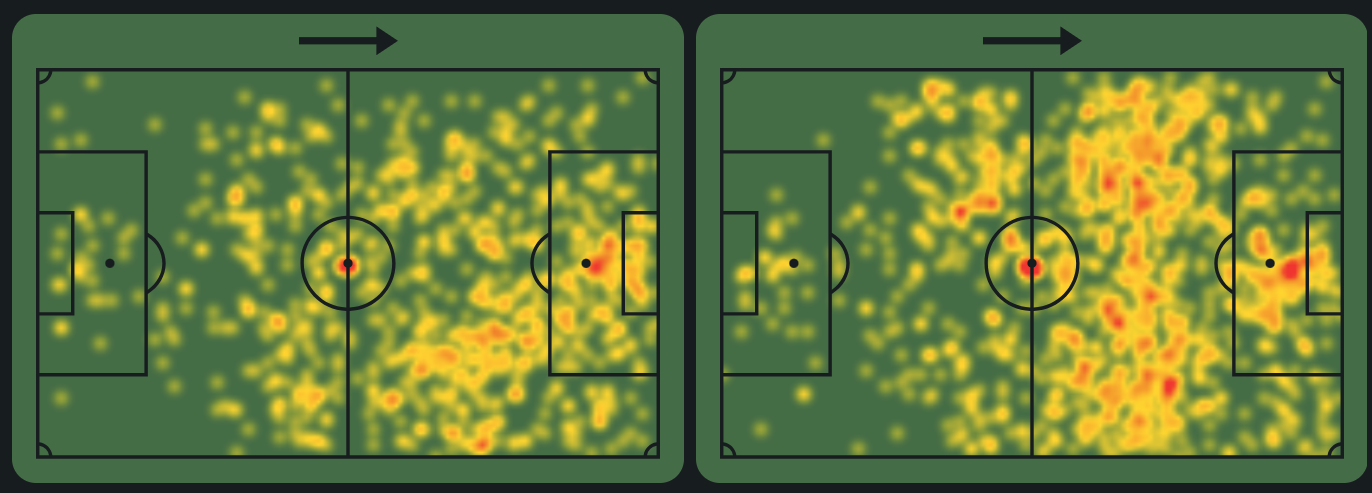
In a more dominant Middlesbrough side, Lankshear will hope to more closely follow Strelec’s heatmap here, allowing him to take up positions more frequently within the penalty box, in which his positioning has been very good for Oxford.
Why Lankshear?
Many might miss that a large portion of Lankshear’s fee has gone into his age and personality. Middlesbrough could have bought a ‘better’ striker for the same fee, but are investing in his potential. He massively bought into a failing Oxford United side, endearing himself hugely to the fans. Throughout the season, he had a clear tenacity and desire to score goals, and also to improve as a player. Last season he scored 11 Championship goals from 11.08 xG; I’d be surprised if he doesn’t work to eventually improve his return on xG. This mindset, paired with his age and academy upbringing, increases his ceiling. Additionally, a successful (for him) season at Oxford in the Championship has helped to prove he’s able to cope with a league which has a blend of physicality and quality that many young players struggle with.
Of course, there are also tactical reasons why Boro are gambling on Lankshear’s potential. In my eyes, the biggest motivator is continuity. Lankshear shares qualities of height, movement, and athleticism with players like Conway and Strelec, whilst also outperforming their xG return, and being younger. Shown by his frequent rotation of both personal and formation, Hellberg doesn’t want to be constrained by player profiles. Having a bank of players who can all play in largely similar ways allows him to tailor a lineup to the needs of the game. Whilst many clubs would hope to build their team around an expensive marquee signing, I believe Lankshear’s profile has been spotted as a player who can imbed into an 11 which is already of the quality and make-up required to push for promotion. Other Middlesbrough signings echo the idea of continuity. They’ve signed another former Oxford loanee forward, Kyle Joseph, who too is much more renowned for his work-rate and athleticism than his goalscoring prowess. One possible solution to Boro’s problems at finishing chances would have been to sign an incredible finisher, Hellberg instead is ensuring that the chances don’t stop being created, even after losing Hayden Hackney.
Even so, this is not to criticise Lankshear’s finishing, which is already of decent Championship standard. However, I wouldn’t rest hopes on Lankshear scoring 20+ Championship goals for Boro next season. Instead, I think his signing should improve on the output of Strelec (who underperformed his xG last season by over 20%), and allow Hellberg to continue playing the very specific and dazzling attacking football he was able to bring to Boro last season.
Potential Concerns
My greatest concern for Lankshear is the possession Middlesbrough were able to achieve last season. On average, they had 59.4% possession last year, 1st in the Championship. In complete contrast, Oxford had the lowest possession in the whole league, at only 39.9% on average. This is a colossal difference in playing philosophies. Lankshear is yet to prove himself in a team which dominates the ball, and I’ve yet to see huge evidence of the quality of his link-up play. Of course, he’s played often for Spurs youth outfits, which may have given him some experience in this area. Additionally, he’ll need to learn how to press conducively, as Oxford generally played a low-block, and certainly didn’t have many joined-up pressing structures; Hellberg will demand this. Boro also topped the table for successful dribbles per game, and ball control is not one of Lankshear’s main strengths. The onus to dribble might not rest on his shoulders from the start, but if he’s to become a reliable part of Hellberg’s attacking options, this might need to improve.
There are clear areas for Lankshear to improve, but I hope he will be able to, given his mentality, and desire to improve. A place in this Middlesbrough team is a huge opportunity for Lankshear to grow as a player, and Hellberg’s coaching could definitely optimise a player already in the conversation as a potential successor to Harry Kane for England. Meanwhile, Oxford will go back to Mark Harris and to League One next year: life comes at you fast.